
Today we are leaving Antigua Guatemala and heading to Peru but first we have to get to Guatemala City airport then to Miami to change planes and then fly to Lima. We have had excellent wifi connections throughout central America – we hope it will be as good in South America, but just in case it isn’t there may not be any blog postings for a while but stay tuned – we’ll be back.
P.S. Whilst uploading this blog the sofa started to shake. As it got stronger we realised we were having an earthquake! The all clear has now sounded.
Monday, 18 January 2010

Fond Farewells
In Chichicastenango we said farewell to David and Roey who were going to Lake Atitlan for a few days before returning to Bexley. The rest of us got back into our minibus and set off to Antigua for our last night in Guatemala. On the way the minibus developed a fault with its brakes and the driver had to phone for a replacement bus to come and pick us up. We met the replacement bus and the luggage was transferred directly from the roof of one bus to the other and we set off again for Antigua. That's our case in the picture

The eight of us from the original twelve who started in Mexico City went for an ice cream in the park and later that evening all of us joined with Natalia, our guide throughout the trip, and Ann, Zoe and crystal for a final meal together before we all fly off on Monday to various destinations around the world – we are not the only ones not returning home.

Farewell also to Natalia and her lovely smile


The eight of us from the original twelve who started in Mexico City went for an ice cream in the park and later that evening all of us joined with Natalia, our guide throughout the trip, and Ann, Zoe and crystal for a final meal together before we all fly off on Monday to various destinations around the world – we are not the only ones not returning home.

Farewell also to Natalia and her lovely smile

Market Day


On Sunday we travelled up into the highlands to visit Chichicastengo where a very large market is held twice a week. The whole town becomes the market, 20,000 Maya live in the local villages and they flood into the town for the market. There are ‘specialist’ streets such as the street of foods, the street of candles and incense, the street of animals where baskets stuffed full of chickens and turkeys are displayed along with pigs held by ropes around their necks, and streets and streets of stalls selling Maya woven goods and the steps of the church which becomes the flower market as the Maya women in traditional dress sell flowers. The town is a strange mixture of commercialism and mysticism as here we encountered another blend of catholic and indigenous religions. There is a time-honoured tradition of brotherhoods focused on saint worship – which are thinly disguised Maya gods. Inside the church, which was full of the smoke from numerous copal incense-burners, amassed around the walls were statues of saints dressed in colourful attire and in front of them people burning candles and murmuring incantations.
We respected the injunction not to photograph inside the church but later in the morning we were able to take photographs of the saints/gods as they were paraded through the streets accompanied by the brotherhoods and women from different villages (identifiable by colours of dress that are unique to each community) as well as musicians creating a cacophony of sounds and, of course, clouds of incense.
The drinking, smoking saint


We visited a couple of villages that border on to Lake Atitlan which are quite typical of Guatemala but they each had their own unique points. The first was one where hippies who moved to this area some years ago have congregated and set up stalls and even small businesses; the air was redolent with dope smoke! The second was a larger town where we visited the shrine of Maximón – a pre-Columbian Maya god that became blended with influences from catholicism in order to preserve belief in it. Consequently he became called by different names such as San Simon or even San Judas Iscariot – hence the reason for people having to give money to approach him. We also had to pay ten quetzales to photograph him.
Maximón is represented by a venerated effigy which resides in a different house each year, being moved in a procession during Holy Week. He has his own small chapel near the Cathedral from where he appears on the Good Friday procession. During the rest of the year, devotees visit Maximón in his chosen residence, where his shrine is usually attended by two people from the representing Cofradia who keep the shrine in order and pass offerings from visitors to the effigy. Worshippers offer money, spirits and cigars or cigarettes to gain his favour in exchange for good health, good crops, and marriage counselling, amongst other favours. The effigy invariably has a lit cigarette or cigar in its mouth and a hole in its mouth to allow the attendants to give it spirits to drink. He is adorned with many colourful garlands including a kipper tie under which money for him was placed.
The worship of Maximón treats him not so much as a benevolent deity but rather as a bully whom one does not want to anger. His expensive tastes in alcohol and cigarettes indicate that he is a very human character, very different from the ascetic ideals of Christian sainthood. Devotees believe that prayers for revenge, or success at the expense of others, are likely to be granted by him. In Maximón’s house there were also statues of saints dressed in the manner of saints in the local cathedral as well as a glass coffin containing an image of the dead Christ.
All very strange and to add to the strangeness we travelled in the local transport – a flatbed truck which has a bar welded in the middle for us to hold on to whilst going along the roads – and we had to hold tight as the roads are full of pot holes.

Sunday, 17 January 2010
Another cup of coffee before we go*
Today we took a boat across Lake Atitlan and visited a coffee plantation; and before you ask, yes of course it was a co-operative where the profits go straight to the growers and not to some fat-cat capitalists and yes of course it was organic. It was really interesting to see the coffee bushes growing in the shade of trees which makes the coffee taste better but the trees are also beneficial to the birds and animals which help to destroy the insects that attack the coffee bushes and also act as natural barriers against erosion in the rainy season when waters run down from the mountains. The coffee beans were ripening and we saw them being picked by hand – picking has to be done by hand because berries on the same branch ripen at different rates. Currently the huge agro-chemical companies are trying to grow GM coffee that will ripen all at the same time so that picking can be done mechanically and put more people out of work. Please boycott GM foods and if possible buy organic and fair trade, you will not only be helping to save the planet you will also be helping to lift farmers like those we saw today out of poverty. This is particularly important in a country like Guatemala where 70% of the land that can be cultivated is owned by 2% of the population.
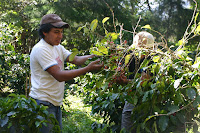
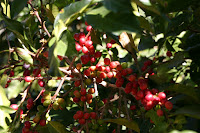
We then saw the processing of the beans – the pulp that is removed from the beans goes straight back as compost on the plants. The beans are washed and then dried in the sun for about 48 hours and are turned every half-an-hour, Gregg had a go with the rakes that are used to turn the beans.
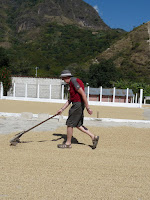

The beans are not roasted here but are sold in their ‘raw’ state to coffee producers in Europe and the USA. Only the finest quality is exported – all the other stuff is used for home consumption and is the stuff we’ve been getting at breakfast most mornings. For a time the greatest contributor to the Guatemalan economy was tourism but once again coffee is now the greatest.
We finished the tour with a tasting; we asked for an “expresso” but this being Guatemala, which operates on watermelon time, they took about 20 minutes to arrive. But it was worth the wait as they tasted very good indeed.
*Bob Dylan


We then saw the processing of the beans – the pulp that is removed from the beans goes straight back as compost on the plants. The beans are washed and then dried in the sun for about 48 hours and are turned every half-an-hour, Gregg had a go with the rakes that are used to turn the beans.


The beans are not roasted here but are sold in their ‘raw’ state to coffee producers in Europe and the USA. Only the finest quality is exported – all the other stuff is used for home consumption and is the stuff we’ve been getting at breakfast most mornings. For a time the greatest contributor to the Guatemalan economy was tourism but once again coffee is now the greatest.
We finished the tour with a tasting; we asked for an “expresso” but this being Guatemala, which operates on watermelon time, they took about 20 minutes to arrive. But it was worth the wait as they tasted very good indeed.
*Bob Dylan
Saturday, 16 January 2010
Antigua and Atitlan


Another sunny day in Antigua and we decided to climb up Cerro de la Cruz, a hill about 2km from the edge of town from where there was supposed to be an excellent view. In the past there have been muggings on the hill so we were advised to go accompanied by a member of the tourist police, so off we went to the tourist police station which is about 1km in the opposite direction from the hill. We wrote our names, ages (!) and nationality in a book and waited for our companion. She soon appeared – all 5 feet of her packing a hand gun in her holster but unlike her colleagues no sub-machine gun, perhaps it wasn’t going to be so dangerous after all. We were joined by two young Canadian women who also wanted to go up the hill and we all set off at a pace that was just a little slower than a run – and she kept this up all the way to the hill, where we had a brief rest before climbing a steep slope and 326 steps (G counted them) to the top where the view was literally breathtaking (the city is about 1500m above sea level). On the way up the only people we saw lurking in the trees were other members of the tourist police force –well it helps keep unemployment down.
In the afternoon back on to a different mini-bus (which was so small Gregg had to sit up front with the driver in order to have any room for his legs) and a drive over the mountains to Lake Atitilan. Two of our group (David and Roey – our new friends from Bexley) decided to stay on in Antigua for an extra day in order to go into Guatemala City to see the anthropological museum, just as well they did as there wouldn’t have been room for them on board the “adrenalin tours” bus (that’s what was written on the side). On the drive we passed through a number of Maya villages where both men and women still wear traditional colourful dress and cultivate the land using implements not too dissimilar from those we use on our allotments and we saw them harvesting carrots and mange-tout (appearing soon at a Waitrose near you) and we also observed an interesting way of cultivating broad beans – in between the rows of already-harvested maize, which had died but still stood there, presumably to help increase soil fertility.
Lake Atitlan was described by Aldous Huxley as “the most beautiful lake in the world” but as he was probably high on locally-produced hallucinogenics at the time we took this with a pinch of salt. We went for a walk by the lake as the sun was setting behind one of the volcanoes that line the shore and thought he might have been right.


Thursday, 14 January 2010

Subscribe to:
Posts (Atom)