Monday, 8 February 2010

Our Arrival on Easter Island


Wherever we go on our world tour, delightful little children, waving flags, line the road as our cavalcade passes but our arrival on Easter Island was special – they even bedecked us with flowers!
We will write more about Easter Island in due course – at the moment though we are enjoying the place so much our faces ache from continually smiling.

Friday, 5 February 2010

Santiago


We came to Santiago because it was from where we could easily catch a flight to Easter Island and so decided to only spend a couple of nights here. Another mistake. Maria from our allotment site (well originally from Chile) and her friend Elaine said we would love it and want to spend more time here. They were right. It is a very sophisticated city (must be, we’ve seen a number of Audis), a very cosmopolitan city (must be, it has people speaking French and good Italian restaurants) and a very modern city (must be, it has bendy buses – Boris is so wrong to get rid of them from London, no let us rephrase that, Boris is so wrong full stop). Despite being a very busy and built up city, it has some very lovely green spaces and many trees. Some of the modern architecture is excellent.
We have spent the day walking around the city, stopping for lunch at one of the many restaurants in the Mercado Central, which incidentally was designed in Chile but built in England and shipped over in 1870, where we had ceviche (and some more Chilean wine – Santa Rita Sauvignon Blanc and very nice it was too, Barry). First of all we went to the Palacio de la Moneda, the presidential palace, where we had to show our passports to get in and Gregg had to have a drink from his water bottle to show that it wasn’t explosive. The guide book said it is considered to be one of the finest examples of colonial public building on the sub-continent, we thought it was on a par with Waltham Forest Town Hall, however the soldiers in their dress uniforms were much smarter than the porters at WFTH!
We also visited the Museo Chileno de Arte Precolombino, which has an excellent collection of objects from the pre-Columbian cultures of Central and South America, so we got to see items from cultures other than the ones we have been visiting. Again there were many fine examples of ceramics but unless we get a special request from David B we won’t be posting anymore photographs.
A bizarre thing about Santiago is sleeping dogs, which lie around everywhere in the city and people just step around them. We couldn’t work out whether they belonged to anyone but they all looked well cared for and very happy.

Let sleeping dogs lie because tomorrow we fly.

Alone Again Or*

Our organised tours are over and we’re back to our own devices, which this morning meant getting a taxi to the airport at 04.30 (this is a holiday?) in order to catch a flight to Santiago – which for some reason has its clocks two hours ahead of Peru – this coupled with it being further south means that it stays light until gone 9pm. Santiago is so beautifully located, standing in a wide plain surrounded by the magnificent Andes. Despite it being a bustling industrial capital it has so many parks and because today was so warm and sunny we took a walk through a couple of them – one was a sculpture arboretum full of strange trees and even stranger sculpture, but there were one or two bronze busts, including one of Pablo Neruda.

The other park was the huge Parque Metropolitano which contains the (very big) hill of San Cristobal which we had intended to reach by the teleférico ( a sort of cable car) but this was closed for maintenance...so we decided to walk up. Mistake. It was a steep climb and the sun was still shining brightly and the temperature was still very warm but we were spurred on by the knowledge that somewhere near the top is an Enoteca with a display of Chilean wines – many of which it is possible to buy by the glass. Dear reader we have to confess that we never made it, the climb and the heat beat us back to our jewel of a hotel that we discovered on the internet called the Meridiano Sur with bougainvillea rambling over the front door and has poems painted on the walls – including one by Pablo Neruda.


In the evening we went to a wonderful vegetarian restaurant just around the corner and sat outside beneath a starry sky. They had a vegetarian version of a traditional Chilean dish called pastel de choclo which was vegetables with onions, olives and large raisins, topped with a maize meal mash and baked in an earthenware dish. We also had a very good bottle of Chilean carmenere reserve wine – when the bill arrived we thought perhaps we had ordered a very expensive bottle by mistake but had momentarily forgotten that 1000 Chilean pesos is equivalent to about £1.30.

* Alone Again Or is a song originally recorded in 1967 by Love. It was written by band member Bryan MacLean and was the opening track on the album Forever Changes

Thursday, 4 February 2010

The group's last supper in Lima


From left to right:
Barbara, Sharon, Liz, Derek, Gregg, Chris and David

Highway 61 Revisited*

Well actually the Pan-American Highway again, on the bus again (which was supposed to have wifi but didn’t) for another seven hours, back to Lima again. But before that we were collected by our ‘chauffeur’ Oscar who took us to Cantalloc. The reason for going there was to see the aqueducts (or are they aquifers?) that were built by the Nazca civilisation between 300BCE and 700CE and are still in use today. As we said yesterday, the Nazca desert is one of the driest places on the planet yet it is able to support a number of sizable communities and produce a wide variety of crops – particularly in the river valleys but as the rivers are dry for about nine months each year they rely on these underground aqueducts. The engineering technique and achievement of what was essentially a stone-age community is truly amazing. The aqueducts run for miles underground and are lined with huge stones with curves built into them so that the water does not flow too fast and damage the channels. At a variety of places there are inspection holes which enables people to keep the channels clear of debris, these, again, are amazing engineering achievements as they descend in a steady spiral so that access can be very easily gained but the spirals are also lined with same huge stones, with the surrounding land being terraced, with the terraces supported by the huge stones – all of this, we were told, prevented the ground collapsing when earthquakes occur and that must be true as the aqueducts are still there, still in pristine condition and still supplying water to the Nazca desert.

Why they built so many inspection holes so close together is another mystery. Oscar even climbed down, filled up a copy of a pre-Colombian drinking vessel and after pouring a small libation on the dry earth, drank heartily of the cold water. He suggested that we shouldn’t drink it because our digestive systems are still not accustomed to the local bacteria so we just poured some onto our hands. (Note: yes we’re still using bottled water to clean our teeth, drinking only bottled water and eating only fruit that can be peeled – well actually this last point is not strictly true as among the wonderful fruit available on the market stalls now includes delightful small black figs and many of you know that we cannot resist figs, so we purchased a bag full, washed them using bottled water, indulged in their deliciousness and had no ill effects. Yum. Perhaps we should also add that Peruvian mangoes are also truly delicious and we’re not aware that we’ve ever seen them in the UK).
In one of the fields next to the aqueducts prickly pear cactus were growing, but these were not being grown for their fruit, which cost next to nothing in the markets, instead they were being cultivated for the parasitic cochineal beetle which lives on the cactus. These are collected and crushed to produce the familiar red cochineal dye (which by and large in the West has been replaced by cheaper chemical alternatives) but is still used in traditional Peruvian woven fabrics. Indeed fabrics woven by The Nazcas 2000 years ago still retain their vivid cochineal red colourings. The photos show Oscar holding the beetles before and after crushing!

On our return to Nazca town we saw some of the shanty towns where people who became homeless as a result of the 1997 earthquake are still living in the most abject conditions. Many of the dwellings are no more than four stout posts (usually bamboo) which have maize leaf matting attached to act as walls and a roof. This is despite an enormous amount of international aid following the quake – much of which was misappropriated by corrupt officials. On the bus ride back we saw a large number of the poorest desert dwellings and vast shanties on the outskirts of Lima; this contrasted greatly with the capitalist dream (nightmare) that Lima has embraced. We got off the bus in the commercial district of Lima which is full of high rise offices belonging to banks, oil companies and other multinational organisations – the sky was alight with the neon signs of Coke, Pepsi and other American products; the billboards announced the forthcoming Beyoncé concert. The social injustice perpetuated by the church and capitalism left us feeling frustrated. Roll on democracy.

Desolation Row

* Bob Dylan's sixth studio album, released in August 1965 by Columbia Records which contains the ever wonderful Desolation Row and Like A Rolling Stone both of which G listened to several times on the bus journey.

Tuesday, 2 February 2010

Nazca Lines and Mummies

This morning we were collected by our driver, Oscar – just the two of us in his car, after all those minibus trips (and yesterday’s marathon bus journey) we felt pretty special. We even got the VIP treatment at the airport and hardly had to wait around before our flight in a Cessna 206 which holds six people – the pilot and five passengers – Gregg had to be co-pilot and sit up front to even out the weight distribution (all those cooked breakfasts!) It was a bit hazy, which is unusual for Nazca as it is located at 600m above sea level which puts it just above any fog that drifts in from the sea. Nazca is one of the driest places on the planet and maintains a temperature around 25 °C (77 °F) all year round and it never rains (so they say) but this morning there was a thick blanket of cloud which Oscar said was very unusual but was getting more common as a result of climate change. Anyway we were soon airborne and it was one of the best experiences of our trip so far – to be looking down on the Nazca Lines and the geoglyphs etched on to the desert floor.
The Nazca Lines have been designated a UNESCO World Heritage Site. The high, arid plateau stretches more than 80 kilometres (50 miles) between the towns of Nazca and Palpa on the Pampas de Jumana. Scholars believe the Nazca Lines were created by the Nazca culture between 200 BCE and 700 CE. The hundreds of individual figures range in complexity from simple lines to stylized condors, hummingbirds, spiders, monkeys, orcas, dogs, and a parrot. Hundreds are simple perfectly straight lines which stretch for miles or are geometric shapes; more than seventy are designs of animal, bird, fish or human figures. The largest figures are over 200 metres (660 ft) across. Monkeys, parrots and orcas are not indigenous to this area and so indicate significant trade routes.
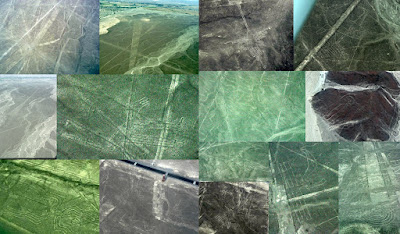
Scholars differ in interpreting the purpose of the designs, but they generally ascribe religious significance to them, as they were major works that required vision, planning and coordination of people to achieve but no one has ever satisfactorily answered why these shapes – many of them over 2,000 years old should have been fashioned in such a way that they can only be seen in their entirety from the air.
Due to the dry, windless and stable climate of the plateau and its isolation, for the most part the lines have been preserved although their presence was not really discovered until people started flying in planes over the desert and by then some of the glyphs had been damaged – one of the worst acts of vandalism being when the Pan-American highway was built right across the Pampa destroying some of the glyphs.
Experts have theorised the Nazca people could have used simple tools and surveying equipment to construct the lines. Studies have found wooden stakes in the ground at the end of some lines, which support this theory. One such stake was carbon-dated and the basis for establishing the age of the design complex.
The lines were made by removing the reddish-brown iron oxide-coated pebbles that cover the surface of the Nazca desert. When the gravel is removed, the light-colored earth beneath shows in lines of sharply contrasting color and tone. The Nazca drew several hundred simple curvilinear animal and human figures by this technique. In total, the earthwork project is huge and complex: the area encompassing the lines is nearly 500 square kilometres (190 sq mi). The extremely dry, windless, and constant climate of the Nazca region has preserved the lines well - the lack of wind has helped keep the lines uncovered and visible to the present day.
Archeologists, ethnologists and anthropologists have studied the ancient Nazca culture and the complex to try to determine the purpose of the lines and figures. One theory is that the Nazca people created them to be seen by their gods in the sky. Dr Maria Reiche who studied the lines for over 40 years (usually from a stepladder)advanced a purpose related to astronomy and cosmology: the lines were intended to act as a kind of observatory, to point to the places on the distant horizon where the sun and other celestial bodies rose or set as many prehistoric indigenous cultures all over the world constructed earthworks that combined such astronomical sighting with their religious cosmology.
Some individuals propose alternative theories. Jim Woodmann believes that the Nazca Lines could not have been made without some form of manned flight to see the figures properly and purported that the Nazca culture had hot-air balloons. Probably the most famous alternative theory was put forward by Erich von Däniken who suggests the Nazca lines and other complex constructions represent higher technological knowledge than he believes existed when the glyphs were created. Von Däniken maintains that the Nazca lines in Peru are runways of an ancient airfield that served beings from another extra-terrestrial culture. Von Däniken's claims, however, are not substantiated by any archaeological evidence and are not supported by scholars.
People trying to preserve the Nazca Lines are concerned about threats of pollution and erosion caused by deforestation of the valleys in the region and the continuing threat of earthquakes (one of which virtually destroyed the town of Nazca in 1997) because of the location of the Pampa on the huge tectonic plate that runs directly beneath. The real fear is that climatic change will bring heavy rain to the area and as the lines are superficial; they are only 10 to 30 cm deep and could be washed away...
After a flight of about 35 minutes we landed safely and not in the least bit queasy – we had been warned not to eat breakfast, which we ignored! Oscar then drove the two of us to Chauchilla – dare we say we were feeling Pampa’d? (groan) Chauchilla is about 30km south of Nazca and on the way he played a Buffy Sainte-Marie on the car CD player – which needless to say Gregg greatly enjoyed. At Chauchilla there are numerous cemeteries from the Nazca period where the dry, humidity-free climate has preserved numerous mummified bodies as well as the tapestries and cloth they were wrapped in as well as the burial offerings that were placed in the adobe brick tombs below the sand. Grave robbers have ransacked many of the tombs and left bones, skulls, mummies and pottery shards littering the desert as they were only interested in the gold. Archaeologists have worked to preserve the tombs and the bodies and we were able to visit about a dozen of them. The bodies were all buried in the foetal position and were placed in the ground facing east – where there is a large mountain shaped like a pyramid but no-one else seems to have noticed this. The tombs reveal interesting things such as the snificant trade routes as the tombs contained obsidian tools and one of them has a mummified parrot (some feathers still intact) and that some of priestly and ruling class Nazcas never cut their hair as some of the mummies have hair about 2 metres long.


We arrived back in Nazca at about 1pm by which time the cloud had burned off and it was sunny and hot – a light lunch and some beer was called for.

Monday, 1 February 2010

On The Road Again*

Our “Essence of Peru” trip finished on Sunday night when the group began to go its various ways with Sharon and David heading off to Brazil before going back to Canada. We said farewell to Barbara, Derek and Liz at about midday and headed off to the bus station to catch our bus to Nazca. We travelled 444km in 7½ hours – most of it through a desert landscape, although parts of it were irrigated and cultivated – there were acres of asparagus. The last couple of hours we travelled in complete darkness, hardly ever seeing any habitation and those we did see seemed to be lit by kerosene lamps so we suppose the TVs must have been battery operated. We arrived to a very welcoming little town, the sky was crystal clear and the stars were shining brightly but it was still about 23 degrees C, we had a nice meal in a little restaurant and are just about to turn in for the night as early tomorrow we have a flight over the Nazca lines and formations.

*On the Road Again - a song by Canned Heat and a song by Willie Nelson and a song from the album Bringing It All Back Home by Bob Dylan and a song by Aerosmith and a song Spanish band Barrabás and the name of an album by Roy Wood